Friday, September 18, 2020

Esperanza Rising Chapter 2: Las Papayas

Today's Goal: CCSS.ELA-LITERACY.RL.6.2
Determine a theme or central idea of a text and how it is conveyed through particular details; provide a summary of the text distinct from personal opinions or judgments.

CCSS.ELA-LITERACY.W.6.6
Use technology, including the Internet, to produce and publish writing as well as to interact and collaborate with others; demonstrate sufficient command of keyboarding skills to type

Today's Agenda:
  1. Entrance Question in the Chat: No hay rosa sin espinas. “There is no rose without thorns” (Ryan 14). What does this phrase mean to you?
  2. Typing.com Intro REAL QUICK
  3. Small Groups to work on previous assignments
  4. Esperanza Rising Chapter 2: "Las Papayas"

End of Class Checklist (Did I finish these things?):
  • Daily Exit Form
  • Triple check that all 3 assignments you have been assigned have been completed. Visit the "Today's Tasks" pages to find the directions if you don't remember what to do.
    • 1. R.A. Discussion Board Questions
    • 2. RACE Paragraph about "The Fun They Had"
    • 3. Summary of Esperanza Rising chapter titled "Las Uvas"
  • Join Typing.com
    • Lessons 1-4 due Friday, September 25!
    • Your overall assignment is to complete the beginning and intermediate levels by the end of the quarter! We will give you a schedule next week!

Small Group Work Time
Ms. Black is going to put you in a breakout room. That breakout room has a very specific purpose. 

Here are the things that you are going to do. It will happen in this order. You will notice that the first three things are PAST assignments. That's because you're going to TRIPLE CHECK that you did each task before you move on to the next thing.

  • 1. R.A. Discussion Board Questions
  • 2. RACE Paragraph about "The Fun They Had"
  • 3. Summary of Esperanza Rising chapter titled "Las Uvas"
  • 4. Join Typing.com and work on the lessons (See video below)

Typing.com
Watch this screencast:

Here's how to join:
  1. Watch the screencast video above. It's 4 minutes.
  2. Click here to join
  3. Click "Sign up with a new account"
  4. Click "Sign in with Google" (DO NOT type anything in.)
  5. Start the beginner levels! (Try to do the first four or five this week!)

Esperanza Rising "Las Papayas"


Wednesday, September 16, 2020

Starting Esperanza Rising and Writing Objective Summaries

Today's Goal: CCSS.ELA-LITERACY.RL.6.2
Determine a theme or central idea of a text and how it is conveyed through particular details; provide a summary of the text distinct from personal opinions or judgments.


Today's Agenda:
  1. Entrance Question in the Chat: What is one thing you do to make yourself feel better when 
  2. Social Contract Question #3: When we are facing difficult situations in Language Arts class, what are the strategies that will help us to solve the problem or get support?
  3. Read Esperanza Rising Chapter One: "Las Uvas"
  4. Objective Summaries!
  5. Catch Up Time!

End of Class Checklist (Did I finish these things?):
  • Daily Exit Form
  • Read Esperanza Rising Chapter 1: "Las Uvas"
  • Watch the screencast about "Objective Summaries"
  • Write my 3 sentence summary of "Las Uvas"
  • Make sure your previous assignments are done (R.A. Practice and "The Fun They Had" RACE Paragraph)
HOMEWORK INVOLVING YOUR GROWNUPS:
  • Please ask your grown ups if they did the homework I asked them to complete last Friday. I sent them an email through Canvas, so if they didn't get the email, they can check the Canvas inbox. (YES I gave your grownups homework. It was to fill out this form. Can you ask them if they got my emails?)
  • You AND your grownups also got an email last night through Canvas asking you about 

Social Contract Question #3
So far we have answered the following together:
  1. What can Ms. Black do this year to show that she respects you and everyone in the classroom?
  2. What can YOU do to show Ms. Black and your peers respect in the classroom?
Today we do our last question!
  • When we are facing difficult situations in Language Arts class, what are the strategies that will help us to solve the problem or get support?
"Difficult Situations" could mean:
  • "I'm very confused"
  • "I don't know where to go"
  • "Technology hates me today"
  • "I couldn't hear the directions"
  • "My sibling was being really loud and I got distracted"
  • "We are trying to work together but ___ is happening"
  • "I didn't do very well on this assignment and I want to do better"
  • "I didn't have enough time to complete my work today"
  • AND SO MANY OTHER THINGS.

Esperanza Rising
We're going to start a book today! You haven't gone to the library to check the book out, but that's okay, we have a copy for you. You will find a link 

If you want to get a book from school, please make sure you talk to your grownups about the homework listed above OR on the "end of class checklist page" in Modules. I sent you a message in Canvas yesterday afternoon.

Prologue:

"Las Uvas" (Chapter One): 


Summarizing
The only thing you have to do for writing practice today is write an OBJECTIVE summary. You have done summarizing before in your life. I guarantee you have. Remember when you watched an episode of a show and your friend asked you to tell them what happened? Remember when you got home from school and your grownups asked you what you did that day at school? Or how about the time when you explained your favorite tiktok video to your bestie? We have all summarized before.

What is the difference between a summary and a RACE Paragraph?

A RACE Paragraph:
  • Answers a question
  • Uses a quote from the text
  • involves explaining what it means (this is called analysis)

An Objective Summary:
  • tells the most important things that happened
  • does NOT include personal opinions
  • is specific, but doesn't explain every single thing that happened (try to identify the KEY things that happened, maybe 3 or 4 things)
Think of it like a list: First, ____. Then, _________. After that, ________. Finally, _______

That is one way of writing a summary. There are LOTS of ways of writing a summary, but the goal is to only explain the most important things that happened and to avoid sharing your opinion.

YOUR ASSIGNMENT:
You will write a summary of "Las Uvas". It should be 3-5 sentences because you want to make sure to be specific, but you also want to make sure not to explain absolutely every little detail. 

You will find the assignment in Canvas. 

Here's a good sentence starter to put at the beginning of your summary: 

In Esperanza Rising by Pam Muñoz Ryan, the first chapter, "Las Uvas", begins in 1930 when __________________. 


We will have more time at the end of class after this. You should use it to go back and make sure that your R.A. Discussion questions are submitted, and that your RACE paragraph from last class is submitted and complete. 

Monday, September 14, 2020

"The Fun They Had" by Isaac Asimov and Your First RACEEE Paragraph

Today's Goal: 
CCSS.ELA-LITERACY.RL.6.1
Cite textual evidence to support analysis of what the text says explicitly as well as inferences drawn from the text.


Today's Agenda:
  1. Entrance Question in the Zoom Chat: Who is your favorite person and why? Can you use RA to answer, please?
  2. Social Contract Question #2: What can YOU do to show Ms. Black and your peers respect in the classroom?
  3. The Fun They Had by Isaac Asimov (1951)
  4. C.E. of RACE
  5. RACE Paragraph Response 

End of Class Checklist (Did I finish these things?):


The Fun They Had by Isaac Asimov

While we read this, there are a couple things you need to know and a couple things you need to look for.

What you need to know:
  • This story was written in 1951. It is science-fiction!
  • The story takes place in year 2155.
  • In the story, it talks about a "slot" where the characters put their homework using a punch code to write out answers. In this story, that's the same as Google Classroom or Canvas, where you turn in your work.
What you need to look for:
  • How does school in 2020 compare to school in 2155? What is similar? 
  • We will need at least one piece of EVIDENCE to use to prove the similarities we talk about.

CLICK HERE for the text! 


C and E of RACE!

We have already talked about R and A together! I will be responding to your posts this week, and I will be responding both with general responses and also feedback! You should DEFINITELY take a look so that you can learn and improve! 

BUT WHAT ABOUT C AND E!?

It's cool I got you covered. 

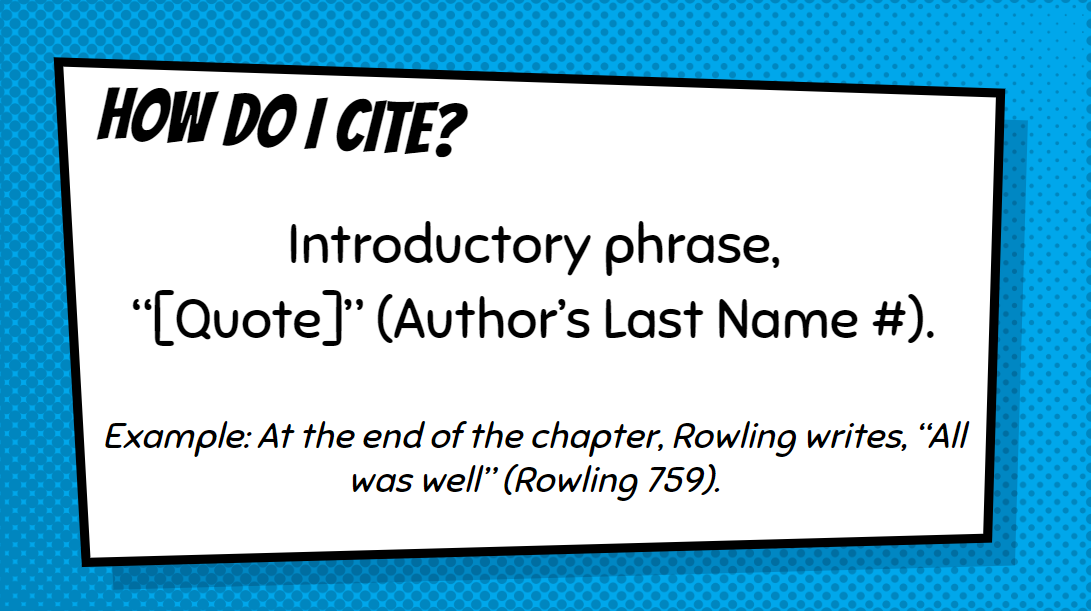
C stands for "Cite the Evidence" and it's maybe the most important new skill we're going to practice together this year. It is ONE sentence that means you are going to copy a quote from the text and provide an in-text citation. An in-text citation is what you put at the end of a quote to prove where the quote came from. 

Here is what it looks like. It has a VERY specific format!


Every C sentences has THREE PARTS:
  1. Introductory Phrase
    examples:
          The author writes, 
          Asimov states,
          Margie says, 
          The writer explains that
          
  2. The Quote
          The quote has to be EXACTLY as written in the text
          The quote has to have quotation marks around it

  3. In-text Citation
         
    You put the author's LAST name (capitalize it) and the page number in parentheses. JUST a number. Do not write the word "page" or "pg" or "#". Then you put the period at the VERY END of the sentence.  

    (Bradbury 34)
    (Pilkey 97)
    (Cameron 123)

Examples:

At the end of the chapter, Rowling writes, "All was well" (Rowling 759). 

The author finishes the chapter by stating that "All was well" (Rowling 759).


E Is your EXPLANATION of the quote.

It must be TWO sentences or MORE. 
Ms. Black will often call them RACEEEEEE paragraphs instead of RACE paragraphs to remind you that E needs to be the biggest part of your response. RA is one sentence. C is one sentence. EEEE is two or three or four. That means when you write your response, MOST of the response will be the Explanation part. 

It's VERY important. The point of explaining is show that you can show your thinking and prove that the evidence is significant. 

You can start your explanation with some of these sentence starters:
  • This is significant because ___
  • This moment demonstrates a similarity to 2020 because ___
  • When __ says this, they mean ___
  • The text proves that _____


"The Fun They Had" RACE Paragraph:

You're going to write your first RACEEE paragraph for Language Arts today! 

Here is the question you will answer: 
After reading "The Fun They Had" by Isaac Asimov, how is school in 2155 similar to school in 2020? 

You will write a RACEE paragraph response for this! 

Here are some sentence frames that might help:

    After reading "The Fun They Had" by Isaac Asimov, school in 2155 is similar to school in 2020 because ______________. In the story, Asimov writes, "_____________" (_______). This moment demonstrates a similarity to 2020 because _________. (then add 1-2 more sentences to talk about it.)


How will this be scored? 
We are looking for TWO things:
  1. Did you do ALL FOUR parts of RACE?
  2. Is your C sentence correct?

Wednesday, September 9, 2020

Social Contract and RA Practice


Today's Goal: 


Today's Agenda:
  1. Entrance Question in the Chat: What's the best kids cartoon show? Why?
  2. Breakout Room Activity / Classroom Social Contract
  3. R.A.C.E. Paragraphs Introduction
  4. RA Practice
  5. Letter to Ms. Black? I don't know if we're going to do this. We will find out together.
  6. Daily Exit Form
  7. Asynchronous Work Time

End of Class Checklist (Did I finish these things?):
  • Daily Exit Form
  • Respond to TWO (there are 3 options) discussion board questions using the R.A. writing strategy. 

Breakout Room Activity
For today's whole class activity, you will be getting sorted into RANDOM groups! You may or may not know these people. If you do not, you will need to introduce yourself! Make sure you know each other's names, please!

Together, your task will be to try to find TEN things that you all have in common. It can be about anything! Your life. Your interests. Your goals. Your Favorites. Things you DON'T like! It might be hard! That's okay. That's the point. Here is a list of things you could try to talk about: 
  • Basic life data: age, school, height, siblings, location, what month you were born in
  • Things you like or dislike: food, show, movie, book, music, color, restaurants, season, etc.
  • Hobbies and activities you participate in
  • Goals for the future
It means speaking with your team and communicating! Also notice that there is a difference between "all of us have the same FAVORITE food" and "all of us really LIKE this food." You might have to look for things that are in the second category and that's okay!

We will come back together after 5-10 minutes and chat!

THEN We will go back to our rooms again and your goal is going to be to come up with TWO answers to the following question:
What can Ms. Black do this year to show that she respects you and everyone in the classroom?

We have THREE questions to talk about, but we're only going to do one at a time. By the time we are done, we will have some goals and expectations that we have created for ourselves. I will ask EVERY group to share the two things they came up with. 


R.A.C.E. Writing Strategy

RACE is a writing strategy we use at TPMS in almost ALL of our classes. The goal is to help create complete, clear sentences and to write with more detail. Knowing these four letters and what they mean will help your writing in EVERY class I promise!

I got you this video:

I also got you this picture:

We are only going to focus on R and A today, which means successfully doing our classwork today means being able to answer a question in one complete sentence. 

I know this is something you are capable of doing! 

You have to do both parts though. 

Here is an example:

What is the best children's television show and why? 

To answer this using the RA strategy, you cannot write:
  • Phineas and Ferb.
  • It's Phineas and Ferb.
  • I think it's Phineas and Ferb.
  • I don't know.
The first three had an answer, but they did not have the R in RACE. The last one isn't an answer at all! Sometimes even if you aren't sure, the best option is to come up with something anyway. I believe in you! None of them explain why, which is part of the question!

Also we are going to practice REMOVING the words "I think" from our writing this year. I know it's what you think because you wrote it! Formal academic writing means that you don't have to state the words "I think." Sometimes it's valuable, but we're going to practice writing without it in our class this year! I will tell you when you can use the words "I think."

To restate the question, you can write: 
  • The best children's television show is ____ because ___. 
  • A really excellent children's show that everyone should watch is ____ because __
There aren't a lot of options here. To restate, you take the question and turn it into a statement. 

Your goal today is going to be to go to the discussion boards on Canvas. There are THREE discussion board options to choose from. You must complete TWO of them. 


RUBRICS and GRADES
This is your first assignment that will receive a SCORE. All of the assignments in our class that receive scores will be scored on a Four point scale.

It looks like this: 
A "passing" score is a 2.5. For this assignment, it means you wrote in complete sentences and you answered the questions using the RA strategy. "Competency" means that you met standards!

To get a higher score, you will be detailed in your answer and make sure to include the reason. It doesn't mean writing more sentences; rather, it might mean writing a more specific sentence and reason. 

To get a lower score, you may have only done one of the two pieces of RA, or you may have not written a complete sentence, or you may have some spelling/grammar mistakes that you can fix. 

If you do not like the score you receive, you will ALWAYS be able to revise work in this class. 

Tuesday, March 17, 2020

School Closures - 16 March 2020 to ?????

Hey y'all,

There's a lot going on and a lot of questions that we don't have answers to. I already miss you all and hope very sincerely that you are staying home and staying safe and staying away from friends. As much as I'm sure you miss them, the safest thing for everyone is to quarantine and help slow the spread of this virus. We may all feel fine, but this is not about protecting ourselves; it's about protecting everyone.

My friends and I call each other our "quaranteam." Do you have your quaranteam? These are the people you talk with regularly and share creativity with so that you are not feeling stuck. We refuse to actually see each other in person, but we're supporting each other in finding ways to be creative and healthy. It is possible to stay connected with people without actually seeing them. We know and hope that the our loved ones are safe, but this is how we doubly ensure that. In watching the news, I saw an interview with a doctor who was asked if we were doing too much by isolating and closing everything. Their response was, "We will never know if we did too much, but we will know very quickly if we did too little." It's a weird time, y'all. I hope we get to see each other again soon, but not too soon.

As for Language Arts, I'm going to bullet point some information based on some of the questions I've been getting:
  • I sent out two emails to parents (and students) on Synergy. Please read them. They contain a lot of information.
  • Only assignments currently in the gradebook right now will be graded for quarter 3. All Ms. Black has left to grade are about 50 This I Believe videos and the ELA Journals. All Revision Requests are currently up to date as of Monday, March 16.
  • ELA Journal grades:
    • Period 1, 3, 5 - Four entries dated March 3 to March 13
    • Period 2, 6 - Three entries dated March 3/4 to March 9/10
  • We will accept Revision Requests until the end of the day on Wednesday, March 25
  • COMMONLIT:
    • Olympic Ski Racers is the ONLY REQUIRED ASSIGNMENT.
    • All others given to you are OPTIONAL. You will get three each week, but they are not required.
  • Please read a book or three or seven by the time we show back up to school in April.
  • Please feel free to email us (including Mrs. H and Mr. Mello) about anything. Please know that if the email is "how do I do this one assignment that was due weeks ago now that I'm not actually at school to do it," I may not have an answer for you that you like. I'm sorry.
  • We would love to hear about what you're reading! Please consider sending us emails about what you've been reading so that we get to hear from you and know how you're doing. We would absolutely love that.

Ms Black, why should I do optional CommonLit articles?
Because it's good for your brain. 
Because research shows that the more you read and practice critical reading while on breaks, the more confident and successful you are when you go back to school. 
Because we've got lots of time on our hands and it will make your families really happy. 
Because challenges are good for you. 
Because you want to show off your writing skills (RACE paragraphs, remember?). 
Because education is what makes us stronger, more informed, more critically engaged members of society.
Because education means PRACTICE.
Because you care about learning and growing.
Because you care about the world you live in.

What other things could I do to keep my brain engaged?
I'm going to let Ms. Keller take the reins here. She put up a whole bunch of ideas for you and your families on her class website, and she'll be updating it in the coming weeks.

CLICK HERE to go to Ms. Keller's class website!

I'll also be on Instagram sometimes, posting things in my stories for you. My instagram is @msblacktpms. See you there!

I love you all. Stay Safe,

Ms. Black

Mrs. H (Period 3)
Mr. Mello (Period 6)

Bonus: Here's a video from one of my favorite authors, John Green, about what it means to be together even when we're apart.

Friday, March 13, 2020

Teens and the News: Say Something Protocol and Annotation - 13 March and 14 March 2020

Today's Goal: How has teen use of social media affected the way that current events are spread and consumed?

The Plan:
  1. Read! (And copy and paste your ELA Journal entry)
  2. "Teenagers are rewriting the rules of the news" article 
  3. Say Something Protocol
  4. ELA Journal
  5. If there's more time, it's a good time for catch-up work.

Homework/Reminders
  • Finish ELA Journal work if incomplete. There are FOUR entries from March so far, including today. Make sure you have all four completed.
  • No Red Ink "Fragments and Quotes"
    • due Friday, 13 March, 4pm
    • if it is completed after 4pm, it will be marked late and you will lose some credit.
  • CommonLit Article of the Week
    • "Marley Dias: The 13-Year-Old Activist & Author"
    • 5 Assessment Questions - due Friday, 20 March, 4pm
    • There is a link on Google classroom or you can log in with Google here

Say Something Protocol

You're going to practice ANOTHER reading technique called the Say Something Protocol using the article "Teenagers are rewriting the rules of the news".

The short directions are in the picture above. 

You will have sentence frames you can use at your table. These stay in the classroom. Please be nice to them and handle them as little as possible. Because GERMS.

Here are the VERY SPECIFIC steps for today's tasks:
  1. Write your name and period at the top.
  2. Write your purpose for reading at the top: How has teen use of social media affected the way that current events are spread and consumed? 
  3. Number the paragraphs with Ms. Black
  4. Make predictions with your partner based on the title and the FOUR headings throughout the article.
  5. Read IN CHUNKS (of like 3-ish paragraphs) to your partner out loud.
  6. After each section, STOP, talk with your partner about what you read. You BOTH have to talk. You have to say NEW THINGS when you talk, and you cannot do the thing where you read the whole thing and talk about it at the end. It defeats the purpose of practicing discussing the smaller parts of the text as you come to them. You don't have to write yet. Just talk.
  7. After you finish, go back and work with your partner to highlight THREE pieces of evidence that show how teen use of social media has affected the way that current events are spread and consumed.
  8. For each of those, you must write a note in the margin that explains why this evidence is an important piece of evidence.
  9. In your ELA Journal, write a RACE paragraph that answers the question: How has teen use of social media affected the way that current events are spread and consumed? 

Here's a new thing you have to do when you write your RACE paragraph:
On the back wall of the classroom is a chart that says "Using Strong Verbs in Argument." You must use this chart today when you write your RACE paragraph. HOW?!?!?

Here's how: When you use evidence you need three things:


What I need you to focus on today, other than making sure you have the author's last name in parentheses, is using a strong verb in your introductory phrase. You cannot use the word "states" or the word "says" today.

Here's the list:

So you could write things like:
  • the reporters discovered,
  • the article challenges,
  • the writer focuses,
  • the teenagers question,
  • the research indicates,
  • [name] believes,
  • [name] reflects,
These are just examples, not suggestions. Picking one of these may not be correct for the evidence you use.


Ready for Catch-Up Time?
  • Make sure all four ELA Journal entries are done.
  • Get your SOAPSTone homework turned in ASAP.
  • Make sure you did your NoRedInk and your CommonLit
  • Triple check that Ms. Black has your This I Believe video because she's missing a bunch.

Wednesday, March 11, 2020

TED Talks and SOAPSTone - 11 March and 12 March 2020

Today's Goal: 
How does screen time positively or negatively affect people’s mental and/or physical health? (R.I.6)


The Plan:
  1. Read!
  2. TED Talks (see below)
  3. SOAPSTone (you'll get a paper copy)

Homework/Reminders
  • FINISH SOAPSTone notes
  • Finish ELA Journal work if incomplete 
  • No Red Ink "Fragments and Quotes"
    • due Friday, 13 March, 4pm
    • if it is completed after 4pm, it will be marked late and you will lose some credit.
  • CommonLit Article of the Week
    • "Marley Dias: The 13-Year-Old Activist & Author"
    • 5 Assessment Questions - due Friday, 20 March, 4pm
    • There is a link on Google classroom or you can log in with Google here


TED Talks AND SOAPSTone

Today you get the opportunity of CHOICE OMG. 

Directions:
You will choose TWO TED Talks to watch today. One must come from the first list, and one must come from the second list. While you watch (and after), you will fill out a set of SOAPSTone notes for each of the videos. You may work alone or with a partner, but if you work with someone, you just have to be watching the same video.


LIST ONE:

LIST TWO:
Some of these have transcripts so you can read along. You can see the transcripts on the TED website. If the link is on YouTube, please make sure you turn on the Closed Captioning so you can read along. At some point, you will need to write down some evidence from the text, so I suggest you be prepared for that.


Okay great, but what is SOAPSTone?

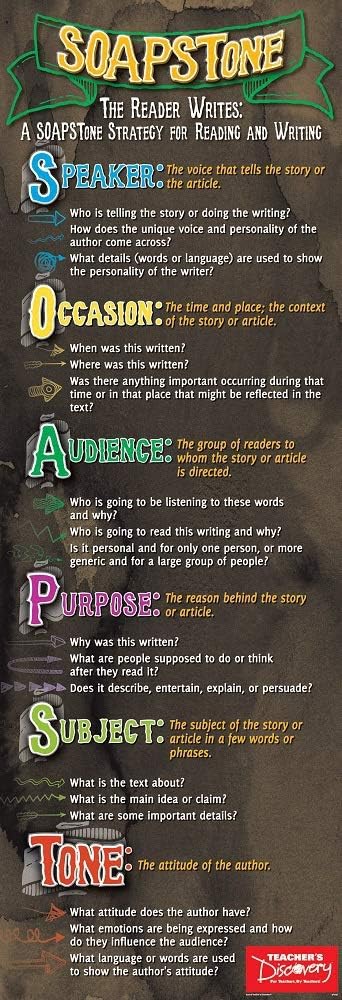
SOAPSTone is a reading (and writing) strategy to help clarify the ideas and purpose of any text, whether it is one that you are reading or writing. When we practice "Marking the Text", we are looking at smaller chunks of the text. When we analyze with SOAPSTone, we are looking at the the text as a whole so that we can identify purpose and meaning OVERALL.

We are going to use it as a way to practice analyzing these videos and you will get notes to work with. The picture above walks through all of the words and what they mean!

If you need words that you could use for TONE, you could click here

You must turn these notes in at the end of class.

Monday, March 9, 2020

Finish Annotating our Article and Finding Author's Purpose - 9 March and 10 March 2020

Today's Goal: 
CCSS.ELA-LITERACY.RI.6.2
Determine a central idea of a text and how it is conveyed through particular details; provide a summary of the text distinct from personal opinions or judgments.

CCSS.ELA-LITERACY.RI.6.6
Determine an author's point of view or purpose in a text and explain how it is conveyed in the text.

The Plan:
  1. Copy ELA Journal from Ms. Black's to yours and then Read!
  2. Read "Teens who spend less time in front of screens are happier – up to a point, new research shows" - practice Marking the Text/annotation
  3. Write a RACE paragraph!
  4. Go to the Book Fair!

Homework/Reminders
  • Finish ELA Journal work if incomplete
  • No Red Ink "Fragments and Quotes"
    • due Friday, 13 March, 4pm
    • if it is completed after 4pm, it will be marked late and you will lose some credit.
  • CommonLit Article of the Week
    • "Marley Dias: The 13-Year-Old Activist & Author"
    • 5 Assessment Questions - due Friday, 20 March, 4pm
    • There is a link on Google classroom or you can log in with Google here


Reading and Marking the Text

We will do this in steps. Some will be together, some will be in partners or groups. Some will be individual. We will not get through everything today and that's okay.

PURPOSE FOR READING: What impact does increased screen time have on teens and their families? 
  1. Write our purpose for reading at the bottom of page 1
  2. Number the paragraphs and divide the reading into sections (together)
  3. Skim the article and BOX any words we should define together.
  4. Read each section out loud. For each section, we will summarize what the section says in the left margin, and state the author's purpose in the right margin.
  5. In groups, identify and highlight FOUR pieces of evidence that help explain the impact that increased screen time has on teens and their families.

Author's Purpose: the author's reason for writing; what is the author trying to DO in that particular section? What is their goal?


Here's the deal: I am going to list NINE "author's purpose" statements here. There are nine sections for you to read.

YOUR JOB: Match the right purpose to the right section, and write it in.

  • describes the study and the results
  • discusses potential next steps requested of Apple
  • compares and contrasts teen happiness to different lengths of screen time use
  • introduces the topic
  • shares an anecdote from a parent worried about addiction
  • shares an anecdote from a parent becoming more lenient with gaming screens
  • provides statistical data on cell phone use over time
  • considers how screen time is affected by their use in schools
  • questions the study's results and advocates for moderation

RACE Paragraph: 
After we annotate the article, answer the following in RACE paragraph form. 
You do not have to highlight.

What impact does increased screen time have on teenagers and their families?

Write your answer here in RACE paragraph form.

Thursday, March 5, 2020

Mark the Text, Summarize, Identify Author's Purpose - 5 March and 6 March

Today's Goal: 
CCSS.ELA-LITERACY.RI.6.2
Determine a central idea of a text and how it is conveyed through particular details; provide a summary of the text distinct from personal opinions or judgments.

CCSS.ELA-LITERACY.RI.6.6
Determine an author's point of view or purpose in a text and explain how it is conveyed in the text.

The Plan:
  1. Copy ELA Journal from Ms. Black's to yours and then Read!
  2. Argument Vocabulary (in ELA Journal)
  3. Quick-write (in ELA Journal)
  4. Read "Teens who spend less time in front of screens are happier – up to a point, new research shows" - practice Marking the Text/annotation

Homework/Reminders
  • Finish ELA Journal work if incomplete
  • CommonLit.org Article of the Week
    • due Friday, 6 March, 4pm
    • You must complete the assessment questions. There are 8 of them.
    • Make sure you "log in with Google" as always
    • YOU CAN ACCESS THE ASSIGNMENT ON GOOGLE CLASSROOM. COOL!
  • No Red Ink "Fragments and Quotes"
    • due Friday, 13 March, 4pm
    • if it is completed after 4pm, it will be marked late and you will lose some credit.

Argument Vocabulary
The concepts we will define together today are:
  • anecdote
  • counter-argument/ rebuttal
  • problem/ solution
  • compare/ contrast
  • cause/ effect
You will likely be able to use a number of these in our reading activity later in class.

Quick-write
Answer the following in your ELA Journal in paragraph form:

How can screens affect your mood? (think about social media, tv time, video games, using your cell phone, etc.) Give specific examples and explain how they are positive or negative or both. 

If you are struggling, think about how long you spend using screens and how that makes you feel. Think about what kinds of things you do with screens and whether those things make you feel happy, sad, frustrated, angry, hopeful, or any other feelings you might have. Be specific about what content you see.

You may use personal pronouns.


Reading and Marking the Text

We will do this in steps. Some will be together, some will be in partners or groups. Some will be individual. We will not get through everything today and that's okay.

PURPOSE FOR READING: What impact does increased screen time have on teens and their families? 
  1. Write our purpose for reading at the bottom of page 1
  2. Number the paragraphs and divide the reading into sections (together)
  3. Skim the article and BOX any words we should define together.
  4. Read each section out loud. For each section, we will summarize what the section says in the left margin, and state the author's purpose in the right margin.
  5. In groups, identify and highlight FOUR pieces of evidence that help explain the impact that increased screen time has on teens and their families.

Author's Purpose: the author's reason for writing; what is the author trying to DO in that particular section? What is their goal?

For the right column, you must use a strong verb to help explain what the author's purpose is. Here is the chart I just put on the wall!


While you may not know what all of those words mean, the goal is to use a word beyond "says" or "said"


Tuesday, March 3, 2020

Screen Time: An Introduction - 3 March and 4 March 2020

Today's Goal: CCSS.ELA-LITERACY.SL.6.1
Engage effectively in a range of collaborative discussions (one-on-one, in groups, and teacher-led) with diverse partners on grade 6 topics, texts, and issues, building on others' ideas and expressing their own clearly.

CCSS.ELA-LITERACY.RI.6.6
Determine an author's point of view or purpose in a text and explain how it is conveyed in the text.

The Plan:
  1. Read! (and also copy/paste ELA Journal work!)
  2. Four Corners Discussion
  3. Screen Time and the Brain by Debra Bradley Ruder - you will find a copy of this in Google Classroom for you!
  4. Finish ELA Journal Entry

Homework/Reminders
  • Finish ELA Journal work if incomplete
  • CommonLit.org Article of the Week
    • due Friday, 6 March, 4pm
    • You must complete the assessment questions. There are 8 of them.
    • Make sure you "log in with Google" as always
    • YOU CAN ACCESS THE ASSIGNMENT ON GOOGLE CLASSROOM. COOL!
  • No Red Ink "Fragments and Quotes"
    • due Friday, 13 March, 4pm
    • if it is completed after 4pm, it will be marked late and you will lose some credit.

Four Corners Discussion

First: In your ELA Journal, you will need to decide your opinions on your own.

Then, we will discuss as a class.


Screen Time and the Brain by Debra Bradley Ruder

We will annotate this together digitally. DIGITALLY?!? Yes. Digitally.
You'll find your copy in Google Classroom.

Here's what we're looking for today:
  1. Purpose for Reading: How do screens affect kids' brains?
  2. Highlight and define words we don't know in YELLOW
  3. Highlight key ideas in each section in GREEN
  4. If we highlight, we must also leave a comment to ANNOTATE.
You will find the following questions to respond to in your ELA Journal in complete sentences:
  • According to the article, how do screens affect the brain? Use evidence.
  • What are two digital media tips shared in the article and why might those have a positive impact?
  • Personal opinion question: How does annotating on an online document differ from annotating on paper? Which do you prefer and why?

Friday, February 28, 2020

Silent Communication and RACE pre-assessment - 28 February and 2 March

Today's Goal: CCSS.ELA-LITERACY.RI.6.1
Cite textual evidence to support analysis of what the text says explicitly as well as inferences drawn from the text.
The Plan:
  1. Read!
  2. Silent Communication Activity
  3. Read the article entitled "High schools are starting to bet on esports"
  4. RACE Writing Assignment
  5. Pre-Survey
  6. Work on CommonLit assignment and/or NoRedInk and/or get help turning in your Video for This I Believe

Homework/Reminders
  • No Red Ink "Fragments"
    • due Friday, 27 February, 4pm
    • if it is completed after 4pm, it will be marked late and you will lose some credit.
  • CommonLit.org Article of the Week
    • due Friday, 6 March, 4pm
    • You must complete the assessment questions. There are 8 of them.
    • Make sure you "log in with Google" as always
    • YOU CAN ACCESS THE ASSIGNMENT ON GOOGLE CLASSROOM. COOL!
  • No Red Ink "Fragments and Quotes"
    • due Friday, 13 March, 4pm
    • if it is completed after 4pm, it will be marked late and you will lose some credit.

Silent Communication Activity

We're going to keep working on that whole "eye contact" thing we talked about last class. This is an in-class only activity. 
  1. You will get a partner today. This partner cannot be someone you know REALLY well.
  2. For three minutes, you're going to do a bit of writing about your partner, which I will explain to you. 
  3. YOU CANNOT TALK.
  4. I REPEAT: YOU CANNOT TALK.

After we talk about what we did in class, you will be doing some silent moving around the room. We will debrief after we finish and talk about:
  • What worked?
  • What didn't work?
  • How important was making eye contact with your peers when it came to being successful in the task?
  • What kinds of feelings do different people have about silence?
  • What purpose could silence serve?


RACE Writing Assignment

Today's task has one goal: gather some data. We've been working on writing all year in formal and informal ways. We've also just finished a large essay in which you were writing about yourself, so as we transition back to writing about what we read a little more, we need to see what you remember about writing argument and using evidence.

You will not get any help on today's writing assignment. NONE. Your task is to read the article and then answer the question in RACE paragraph format. I need to see what your best is so I can help you make your best even better.

Here's the trick, though: the better you do and the more effort we put into it, the less lecture you get from me about things you already know in the coming weeks because I won't have to bore you while I reteach something that you are capable of doing. 

IDEAL: Write a RACEECEE paragraph, not RACE. Like I said, I need to see your absolute best without my help, so most of you should be using TWO pieces of evidence, not one. 

Task steps:
  1. Read the article entitled "High schools are starting to bet on esports"
  2. Answer the question provided in RACEECEE paragraph format. You do not have to highlight.
  3. Use any resources on the document and around the room that you would like, but Ms. Black and Mr. Mello and Mrs. H will not help. 


Pre-Work Survey

The purpose of this survey is to get a before and after picture of this RACE paragraph and one that you will write in the future. I need to know your perceptions and ideas about what we've been doing in order to see if that changes.


What DO I DO when I'm done?
  1. Please fill out this survey after you complete the RACEECEE response.
  2. This I Believe Video needs to be turned in. There's too many of you that have no submission.
  3. No Red Ink Due today.
  4. CommonLit Article due next Friday.
  5. Read

Wednesday, February 26, 2020

Book Talks and Email Etiquette - 26 February and 27 February 2020

Today's Goal: 

The Plan:
  1. Read
  2. Book Talk Time - Focus on EYE CONTACT
  3. fill out this form AFTER book talks
  4. CommonLit.org Article of the Week (this is the assignment you'll do instead of typing from now on)
  5. Email Etiquette/Sending Formal Emails

Reminders/Homework:
  • No Red Ink "Fragments" 
    • due Friday, 27 February, 4pm
    • if it is completed after 4pm, it will be marked as late and you will not get full points
  • CommonLit.Org Article of the Week
    • due Friday, 6 March, 4pm
    • You must complete the Assessment questions. There are 8 of them.
    • Make sure you "log in with google" as always
    • YOU CAN ACCESS THE ASSIGNMENT ON GOOGLE CLASSROOM. COOL! 
  • No Red Ink "Fragments and Quotes"
    • due Friday, 13 March, 4pm
    • if it is completed after 4pm, it will be marked as late and you will not get full points

Book Talks!

  • You will have 90 seconds to share a book that you are reading with your group members.
  • You must have the book with you, either as a physical book, or pulled up on Overdrive.
  • You must be either currently reading the book, or have finished it within the last 2 days.
  • You must talk for the full 90 seconds without stopping.
  • Here are some things to talk about:
    • Introduce the title, author, & genre of the book and give a brief summary (try to avoid spoilers if you can!)
    • What do you think of the book so far? Are there specific things that you like/dislike? Would you recommend it to your classmates? Why/Why not?
    • Who is your favorite character?
    • Who is the worst character?
    • What's the funniest scene so far?
    • What do you hope will happen as you keep reading?
    • What do you think will ACTUALLY happen when you keep reading?

You will fill out THIS FORM after everyone has had the chance to share.


Once you finish, I suggest you go log in on CommonLit.Org so you can see your homework. This is what will take the place of Typing.com on weeks you don't have a NoRedInk assignment.

Sending Formal Emails (Email Etiquette)


Slides 19-24 have your assignment.

You can also use the templates, where applicable, that you can find on the new button at the very very top of the blog called "Sending Formal Emails!"